This sequence is adapted from The New Yorker piece, The Delhi Walla’s Visions of a Possibly Vanishing India, by Karan Mahajan.
Here’s the link to the article:
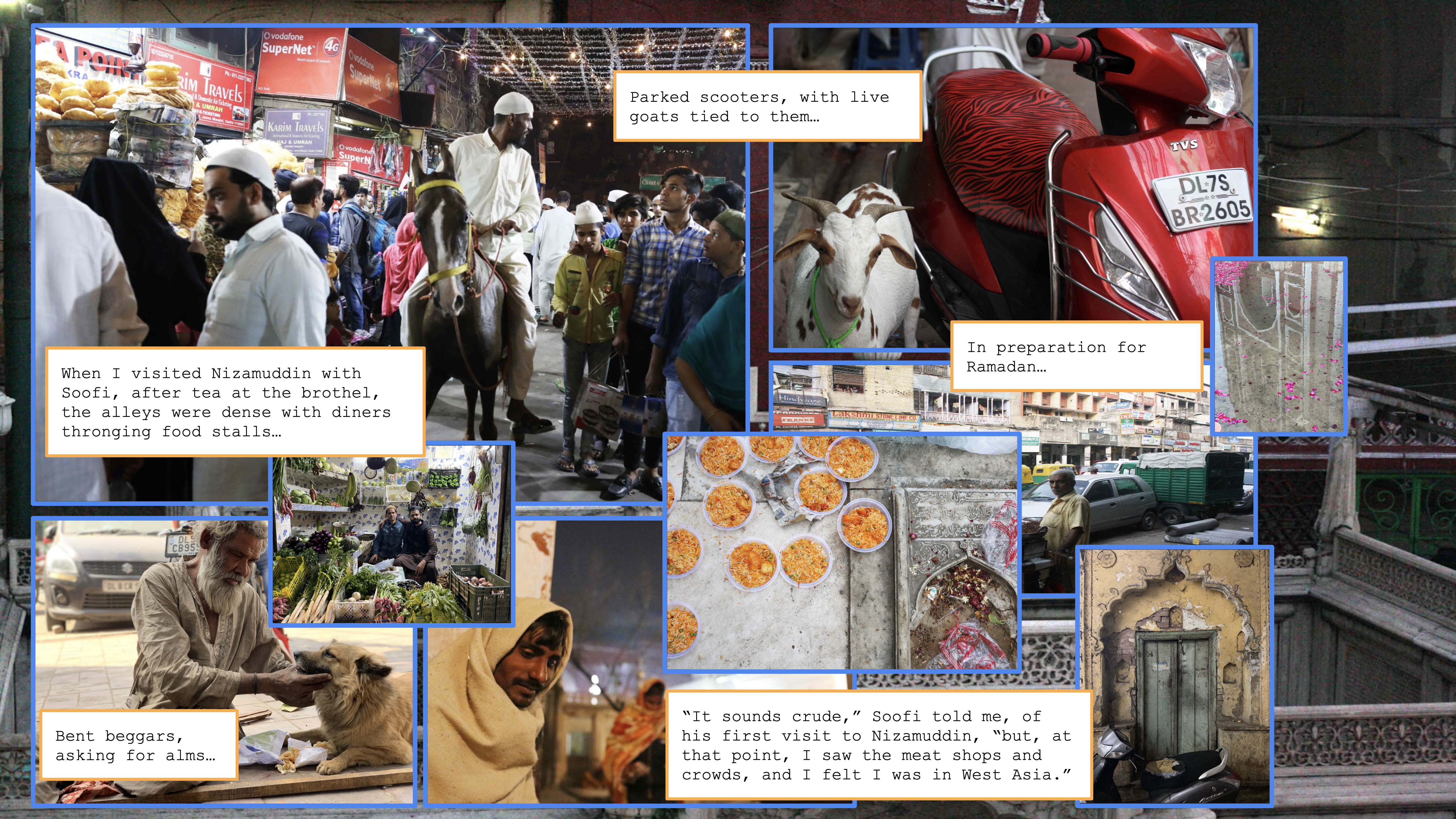
These panels depict the scene in Mahajan’s article where Soofi is making his usual visit to Nizamuddin, with the reporter in tow. The aspect of the story this sequence communicates is a return to Soofi’s origins as a blogger and content creator, which allegedly began during a visit to the Sufi tomb years before.
According to Mahajan, Soofi “glimpsed the secular and pluralistic India that he had previously only read about in books and seen in movies.” To me, as I read this part of the story, it felt like this Sufi tomb in Nizamuddin represented the vision that the Delhi Walla yearned to impart on his readers. This was a place of multiple faiths, promoting coexistence and compassion among its visitors. This tomb brought people together from many different neighborhoods in Delhi, which bares a certain similarity to the goals Soofi vowed to achieve, like spreading the voices and stories of people from underrepresented areas, and embracing the different cultures and subcultures present all throughout Delhi.
Soofi is a creator with a dense body of work. He does so many different things, working in multiple mediums and covering a variety of topics. This could make it hard to understand his work and vision from a broader standpoint. However, when I read the section which I adapted into the comics sequence above, I felt like I understood Soofi better in a general sense, as a subject.
That is why I believe this scene is so important to include in my adaptation. In my final draft, there will be more panels devoted to this scene, and exposition of how it so significantly marked the beginning of Soofi’s blogging career.
Looking more specifically at the techniques I employed in creating the sequence, the first thing I wanted to do was pick a style of transition. It seemed best to cover this bustling display of life in Delhi with McCloud’s Aspect-To-Aspect transition technique. Having been to India myself, many years ago, I remember the overwhelming sensory stimuli in the streets of its metropolitan cities. My head was rotating back and forth, eyes darting around wildly, as my brain attempted to instruct these motions and process the light speed imagery simultaneously. In that regard, I felt it was appropriate to include different sets of panels, with varying dimensions, to emulate the quickly-shifting perspective you experience on-foot.
Next, I decided to include text from the article, layering context and narrative structure within the Aspect-To-Aspect transitional framework. Since this sequence of the adaptation would be essentially collaging imagery to accompany a written report, I utilized some of McCloud’s techniques accordingly. From the chapter, “Show and Tell,” the combination of words and images were styled as a mix of word-specific and additive. Looking back over this sequence, I realize that the word-specific combination is most prominent. Mahajan’s written imagery is so strong, and narrative focus so intent, that the words deliver the bulk of the meaning and context for this part of the story. My desire was to simply enhance the writing with images. The brilliant color palette of Delhi’s streets, I thought, could bring new life to Mahajan’s piece.
All of these images were taken directly from the Delhi Walla blog site. I used the search feature to narrow down blog entries that exclusively captured parts of Nizamuddin, and I tried as best as possible to keep the photographs in proximity to the Sufi tomb.