When I first began trying to think of an idea for my original piece of comics journalism, I experienced a struggle. The only ideas I could come up with were either boring, too niche to get more than one source on, or just downright stupid. My ideas tend to lean toward fiction rather than nonfiction, and so trying to come up with topics for journalism in my own life can be tricky.
I took a break, and a long walk, after initially trying to think of ideas for the project, and then an idea approached me on its own. I started thinking about how my inclinations are usually drawn towards artistry or creative production, and so I could just do my story on the other people who feel this way at Muhlenberg. Also, I’m taking my Senior CUE in digital media production this semester, so I’m thinking I could interview some of the other students in that class for sources/subjects in the comic.
The next thing I considered was visual/illustrative style. It dawned on me that the narrative here wasn’t exactly dynamic enough to justify the typical panel-to-panel action that follows story by plot guidelines.
This was the next struggle of the brainstorming process. I couldn’t think of a good style to draw inspiration from, out of the examples we’d looked at so far in the course. Then, while in class this previous Wednesday, I had an idea.
We were discussing Olivier Kugler’s piece of comics journalism capturing a refugee camp in Iraqi Kurdistan, and the distinct visual style used to create it. While looking at the single-panel scenes that focused on individual, enclosed locations as a means of character and story, I got the inspiration I was looking for.
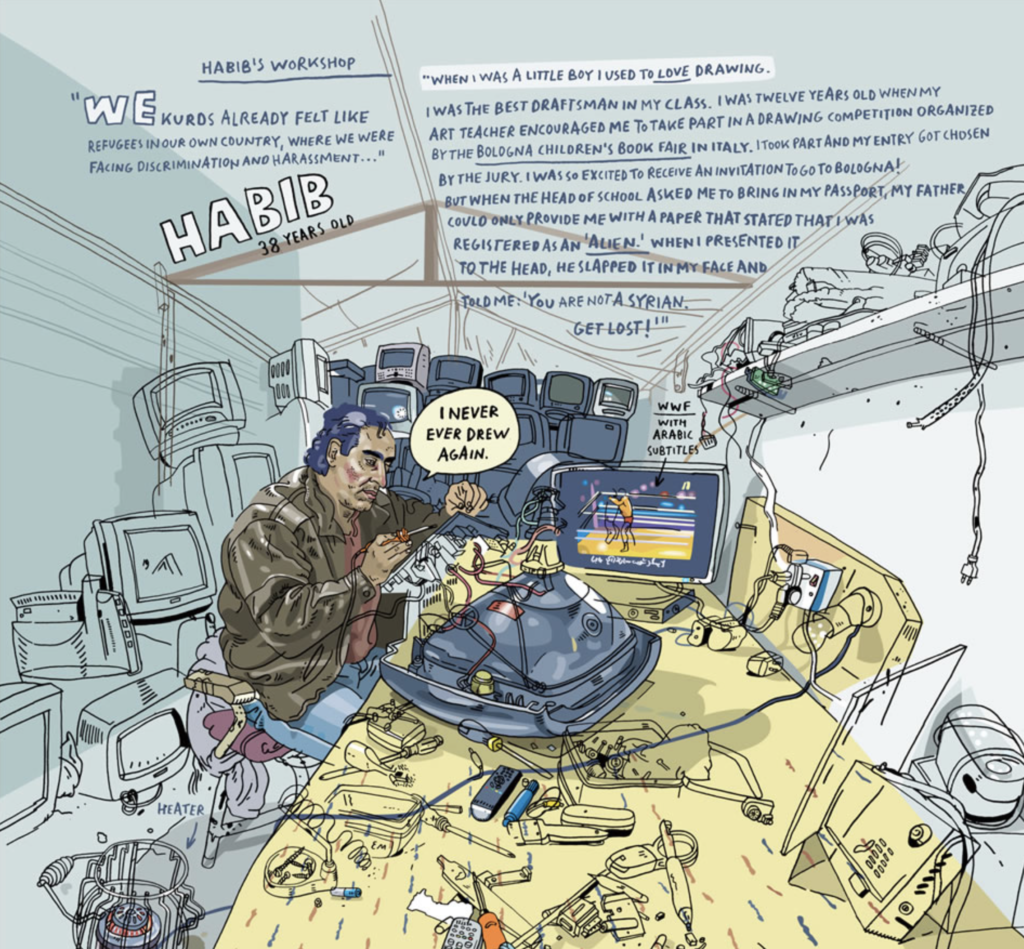
Artists often lend great personal value to their workspaces, whether that consists of a small desk shoved in the corner of a tiny room, or a sprawling studio filled with tokens of past projects and the skeletons of current ones.
Building from this idea, I think it would be cool to interview some of the creative students in my CUE course and then plan a full-page panel for each subject that depicts them in their primary workspace, framed by small blocks of text in a more free-form layout like Kugler’s rather than balloons.
I think it would be important for current and prospective Muhlenberg students to know about this topic because it could help illuminate what the core of media & communications (from a production perspective) really is. The story could demonstrate the kind of peers that students will have if they choose this path, and also the kind of work they’d be doing. I think it will also be important because it highlights the freedom and individuality that any student can bring to this program of study, from a creative standpoint.
The first person I would interview would probably be Lyn Nguyen, a senior in the CUE course. I would like to interview her first because I’ve had multiple classes with her in the past few years, and have seen her grow as an artist, so I’d feel more comfortable trying to depict her creative career and workspace with at least some level of accuracy.
I’m also considering interviewing our CUE professor, Anthony Dalton, which could draw a cool parallel and relatability between creative students and their professor. Also, I’ve seen Tony’s office workspace and it would make an interesting visual environment to draw his character in.