As discussed in the Davies article, Joe Sacco, in his book Paying the Land, uses lines as a visual symbol for the colonial relationship with the natural landscapes and environments of Earth. This visualization can occur in many different representations, such as the fracking tunnels and mineshafts gouged into the ground, or the seismic lines printed on maps for Western enterprises, just to name a couple.
On the other hand, Sacco employs the visual symbol of the circle to provide a stark contrast. The circle is a visual motif affiliated with the traditional Dene culture originating from life in the bush. Quite different from the colonial mentality, the circle emphasizes respect for the land, and a system of values that prioritizes living responsibly and ensuring a prosperous future for the coming generations. The circle can be most strongly likened to a diagram of generational heritage and tradition. While it has faced significant adversity, Sacco makes a point throughout the story to argue that the circle is still intact for the Dene.
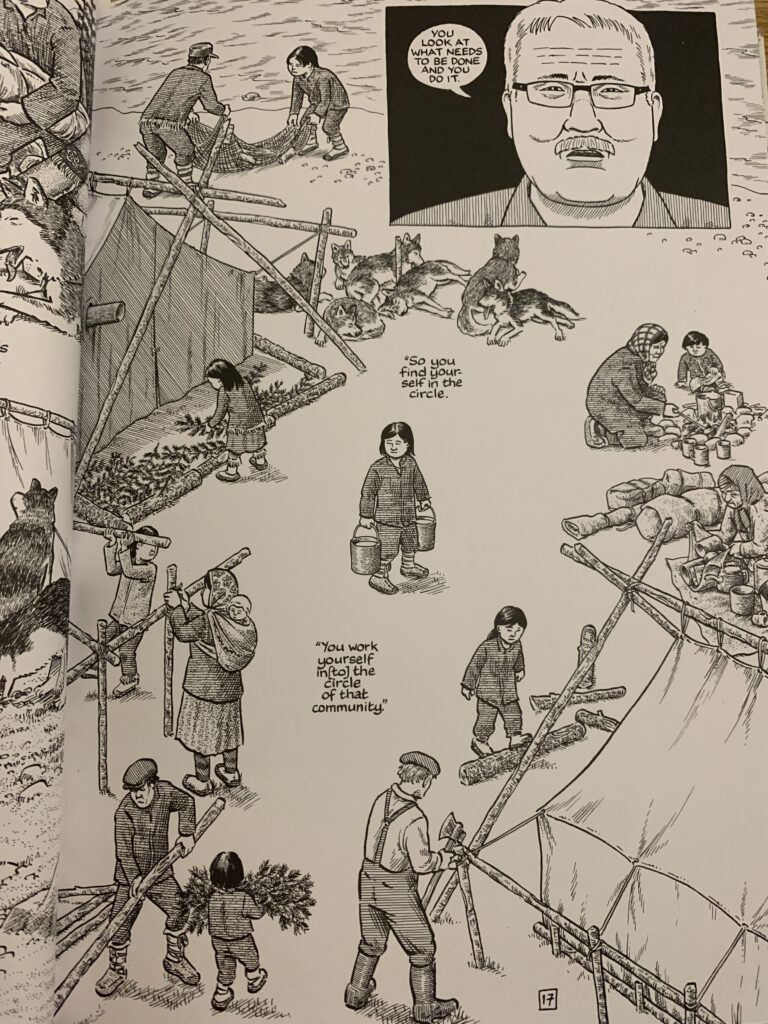
In the image above, from page 17, readers are first introduced to the circle as a visual symbol. Paul Andrew recounts his upbringing in the bush. He describes the traditional relevance of this symbol, after reporting on the way adults and elders showed the children how to perform all the important tasks, then expected them to start pitching in. “So you find yourself in the circle. You work yourself into the circle of that community.” This quote is from Andrew describing the moment in his childhood when he moved past the phase of mere spectatorship and learning, and began to insert himself in the family workflow.
Sacco, with Andrew’s testimony, shows us the traditional “bush” life of the Dene peoples. This was a community that only took what it needed from the land, and made sure to pay it back. This was a community that nurtured and responsibly raised their children to act the same way, with the same respect for the natural world.
I personally connected to this visual symbol, and its underlying message, quite strongly. For the second half of my high school career, I enrolled in special programs that gave me a unique school experience, removed from the 21st century reality in capitalist America. The first program had me spend 15 rugged weeks living in the Blue Ridge Mountains, far removed from civilized infrastructure and people. There were about 11 students in the group I was placed with, and three adult staff. This was a similar “bush” lifestyle. We slept under plastic tarps, migrated to new areas every two days, and carried only the bare necessities. This lifestyle required interdependence within the group. Skills, rules, and knowledge were passed down from the senior-most students, who’d been there the longest, more than the adult staff members. In this way, my experience resembled the circle that Sacco uses in his book.
This personal connection definitely creates a bias for me, that leads me to pay much more attention to the circle as visual symbol. But, I think that it is a significant part of Paying the Land. There are multiple instances where Sacco discusses how it might be too difficult to return to the bush lifestyle now, and this opinion is reinforced by some of the Dene people who provide testimony. And there is certainly validity in the belief that the world has moved too far in the direction of technological advance to revert to a primitive lifestyle. But, Sacco makes the argument, as well as some of the Dene testimonials, that mere exposure to the traditions, and the lifestyle, can still be very helpful.
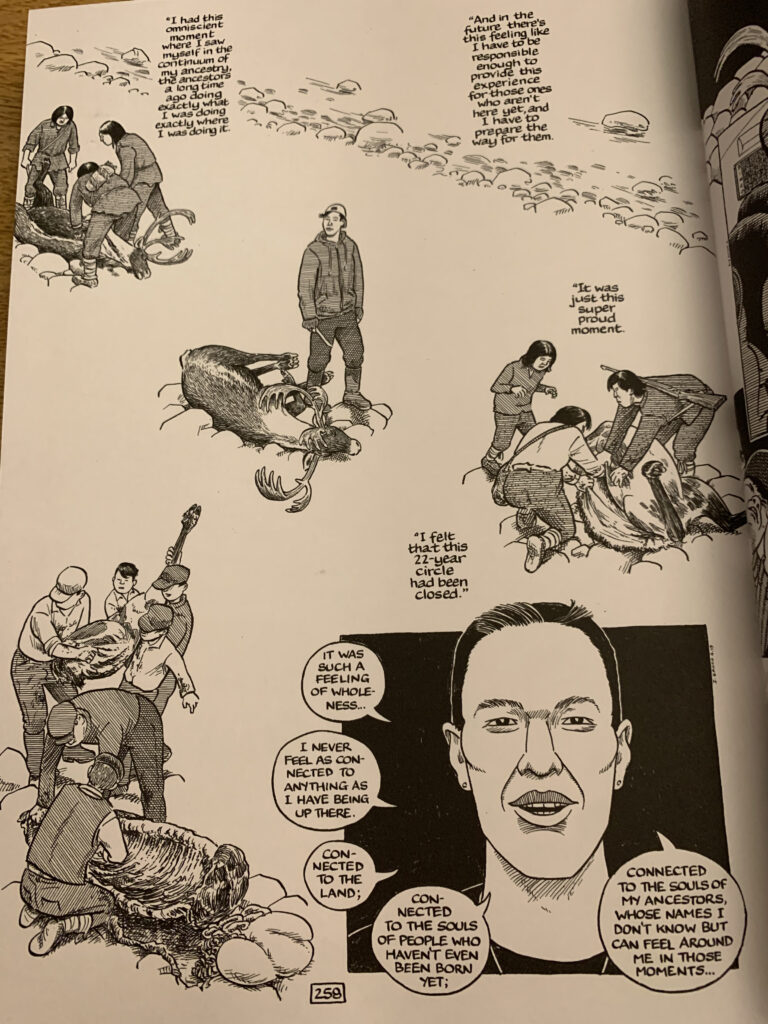
The image above, from page 258, comes from the final section of the book. Sacco illustrates another generation of Dene youth finding themselves in the circle, claiming that the tradition is still alive even if on a much smaller scale. This was a hopeful note to end things on, one that suggests the circle could still outlast the colonial/seismic line which tries to combat it.