For our in-class exercise this Monday, I created a personal explainer comic that briefly introduced one of my personal theories about how to grow as a creative writer of any kind.
The first step in this process was to think of two symbols, after consulting McCloud’s excerpt on representation by symbols. Since I’m not an artist or illustrator like McCloud, I figured it would be best to stick to the simple, cartoonish end of the visual symbols spectrum where symbols like the peace sign reside.
The concept I had in mind was likening writer’s block to a brick wall that one crashes into while they’re writing, once they’re run out of energy. It’s common for writers to commit to a regimen of writing for a certain amount of time every day, or writing a certain amount of pages. These are certainly valid techniques and can help any writer. I used those techniques for a long time and they definitely helped, but after a while I refined my own technique.
Instead of writing for a set amount of time, I would simply write for as long as I could, until I lost focus, ran out of energy, lost creative inspiration, or all three. I was familiar with the “brick wall” of writer’s block, and so I decided to work on increasing the time it took me to hit that wall. This practice made it so that I wasn’t just hitting a certain page count ever day even if half the pages were uninspired. Instead, I was able to write for longer periods of time, and have that writing maintain a more consistent quality throughout.
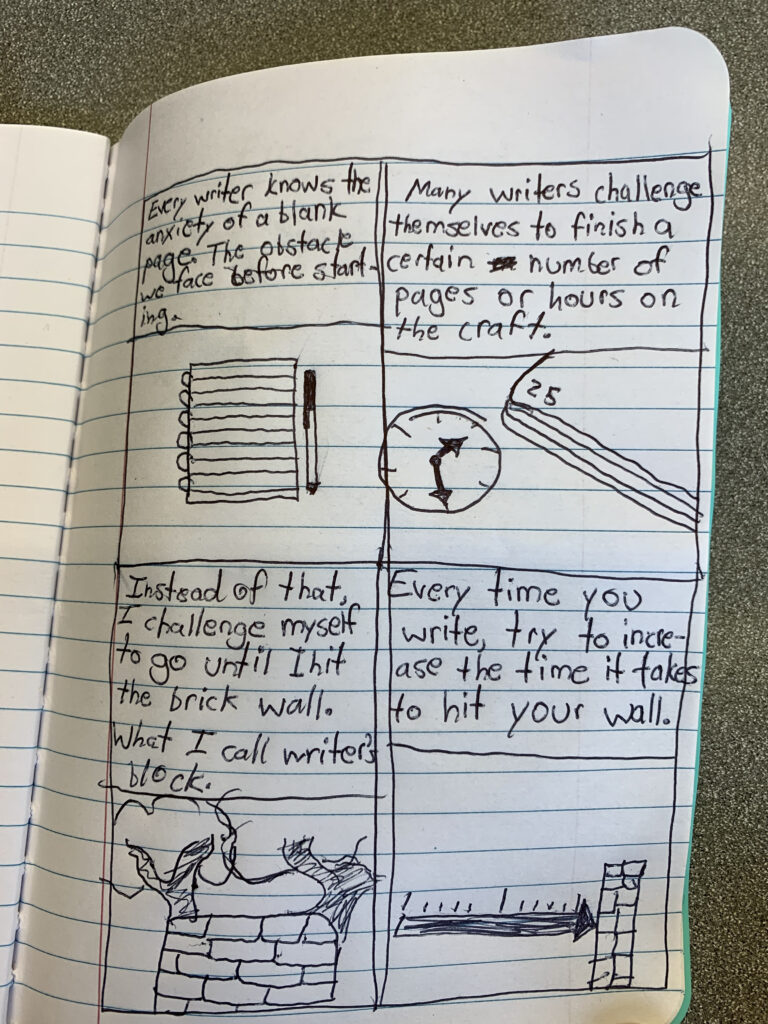
The two symbols that I created for this brief comic were the brick wall and the measurement-etched arrow. I already explained what the brick wall represents, and the arrow symbol was used to represent time as psychological distance. These were the two most important symbols.
This comic was influenced by Andy Warner’s Carbon Control. There were a few instances in which Warner used pretty basic symbols to depict anything from commodities, chemical formulas, forms of infrastructure, etc. Since I wouldn’t be citing actual research or scholarship in my explainer comic, I figured this use of symbols would work best, compared to the charts and graphs that Warner integrates.
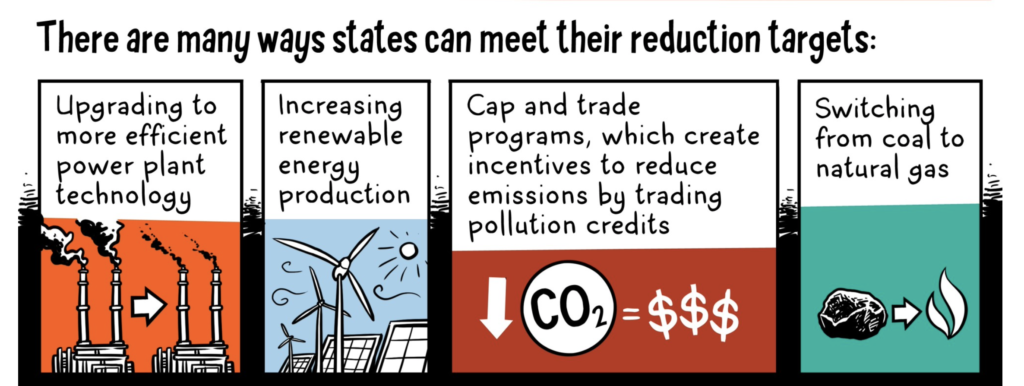
Obviously the visuals are much cleaner and more effectively presented here, but this was the general idea of visual symbols that I was going for. I learned how effective visual aid can be when trying to explain concepts and issues, or anything really. From reading Warner’s Carbon Control, I was reminded of infographics and how helpful they can be in the fields of medicine, science, business, and social discourse. While I enjoy reading plain-text articles about environmental, economic or political issues, it really makes the act of learning and understanding these sometimes complex, nuanced topics a lot easier to have symbol-based visual accompaniments. I believe that the explainer comics medium should be utilized more in news and informative media, given how much the digital landscape has eroded our population’s attention span.