In analysis of the comics journalism book, Threads by Kate Evans, Harriet Earle discussed the use of lace as a formal element that represents the ties between white European colonialism, production, and the displacement of people from all over the world.
I found Earle’s scholarship very interesting and saw validity in many of the points made. After skimming through the chapters in Threads a second time, after having finished a full read before, I noticed there is another formal and narrative element used to depict something very important to Evans’ story.
The Good Chance Theater Dome stuck out to me since its first appearance on page 33. From a visual standpoint, the theater looks quite strange, like a futuristic crystal enclosure swallowed by the Jungle’s squalor all around it. As somebody, who’s seen countless hours of television news footage panning over the endless rows of tents, shacks, and lean-to’s of refugee camps around the world, this magnificent dome was the last thing I expected to see.
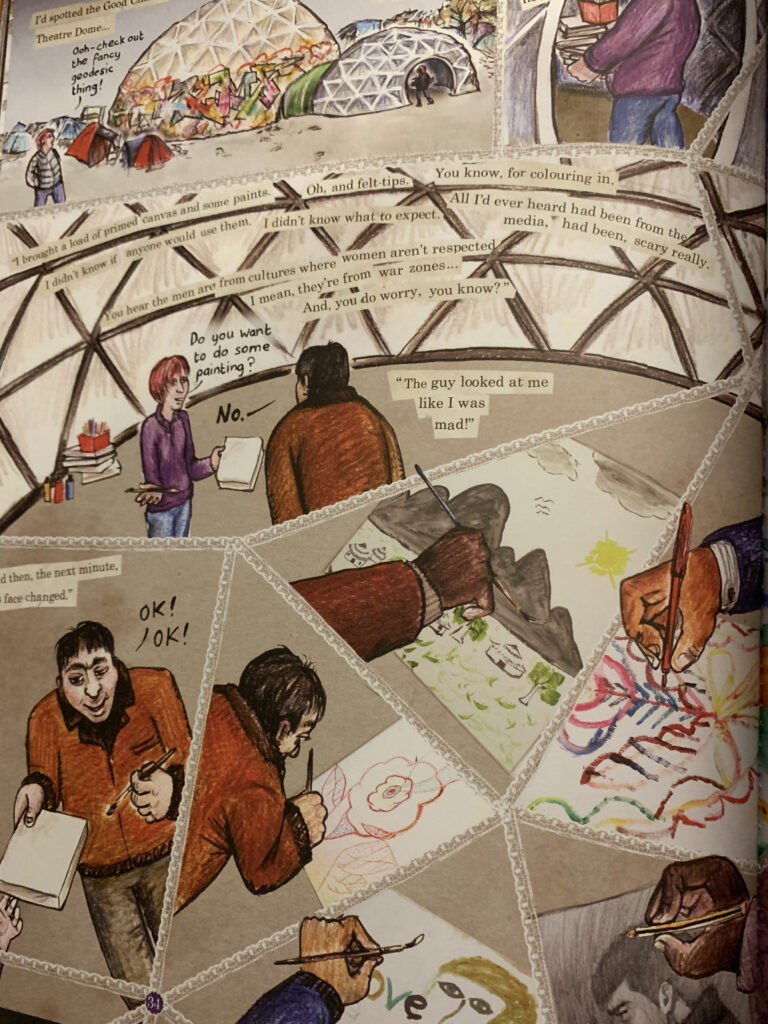
Graphically, it somewhat resembles the comic panels, and how they’re cut into shard-like asymmetry by their lace borders. Though, the visual resemblance mostly ends there, because each fragment of the Theater Dome is symmetrically placed amongst the others. The pieces stand together and remain intact. This seems like an ideal fantasy where each creed, faith, ethnicity and nationality can stay in place rather than being displaced. It’s the faintest underlying message or representation of this formal element, but it’s important nonetheless, and helps set up the next.
On page 34 (featured above) we see the character Sue walking into the Theater Dome for the first time and offering paint supplies to a grown man waiting inside. He reacts with a hardened exterior at first, but quickly lets his guard down. We see him begin to paint and draw various images with Sue.
The visuals remind me of an art classroom for young children, where you walk past in the hall and see their work on display. I was so vividly brought back to the times I’d walk through my middle school and see that exact sight. I’d try to discern personal information about the students in whichever class facilitated these creations. Moving back to the page in Threads, it’s as if this grown man is finally getting to have an experience like that – of safe and almost juvenile self-expression. The next page helps solidify the visual metaphor in my opinion, so I’ll include it now.
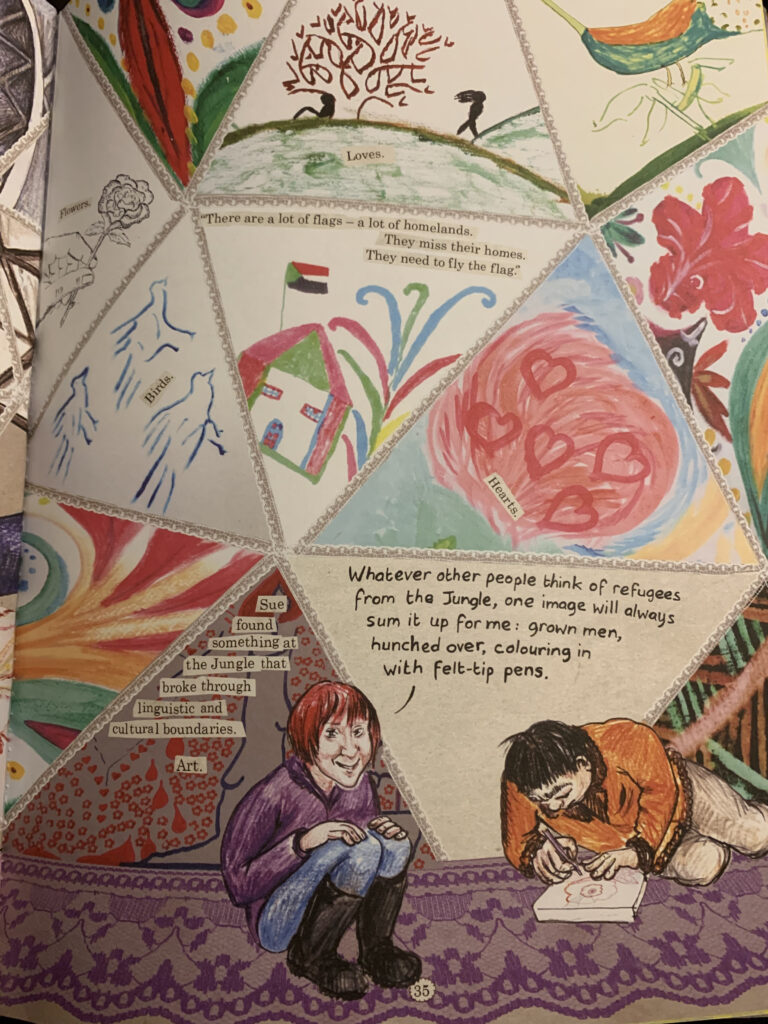
The panels on this adjacent page are filled with the artwork of displaced people. “There are a lot of flags – a lot of homelands. They miss their homes. They need to fly the flag.” Metaphorically, this still resembles the lace, but an interesting shift occurs that distinguishes this deeper meaning as relevant specifically to the Good Chance Theater Dome. Looking at the top 3/4s of the page, each of the panels containing artwork in combination together begin to resemble the fragmented shape of the Theater Dome itself.
Starting at page 35, I suspected the dome would be used a visual metaphor for the childhoods that these displaced people should have experienced – times of peace, family, love, and personal growth. In the case of many children and adults living in the Jungle, no such reality would be within reach.
Jumping forward to page 111, we can see another distinct instance of this metaphor. I will include the page here.
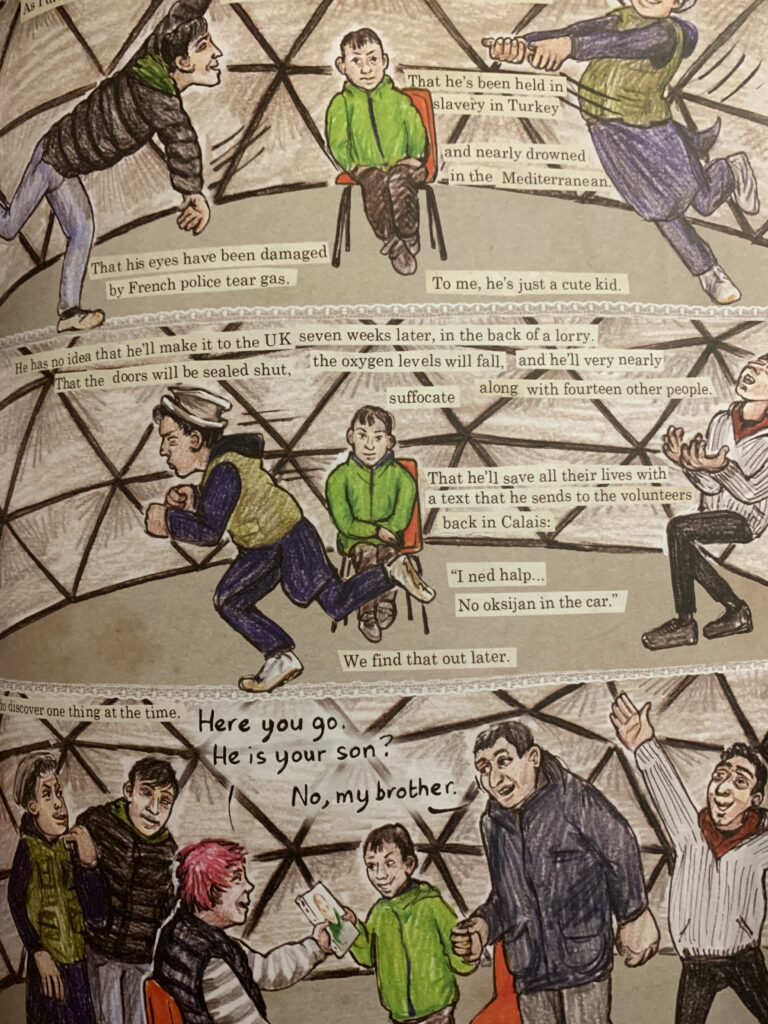
Evans sits this child in the green jacket down, so she can draw his picture. Inside the dome, surrounded by fun and games, she sees his withdrawn sense of gloom, something alarming in such a young child. The text starting in the top panel reads, “As I draw, I have no idea that this child has walked from Afghanistan over mountain ranges without food or water. That he’s been held in slavery in Turkey and nearly drowned in the Mediterranean. That his eyes have been damaged by French police tear gas.” This is a very alarming realization about such an innocent looking young boy.
When considering an individual so young having such gruesome experiences, is it possible to then provide any semblance of a healthy or conventional childhood to that person? Other people inside the dome are pretending to play cricket, or other games. Evans many times throughout the book expresses concern for how these children will turn out as adults, filled with hatred and yearning for vengeance against the colonial powers responsible for their trauma. While it’s understandable how they’d reach such a state, it’s still something that needs to change.
The Good Chance Theater Dome represents, in my opinion, a very cynical perspective on the struggles of displaced peoples. When they enter the structure and play games, draw, or paint, it’s a charade. It’s theater. For some people, it certainly would help them cope with the unforgiving reality they live in. But that seems to be the extent of this dome’s ability – providing some help with coping. There is no way to give these children the childhood they deserved. As soon as they leave the confines of this fractal enclosure, the illusion is shattered and they once again have to traverse the squalor, locked behind miles of fences.
Evans’ use of the Good Chance Theater Dome expresses a significant message in a similar framework as her use of lace as a formal element. As people all over the world continue to have their childhoods ravaged by war and colonial occupation, or the residual effects of both, the idea of restoring those childhoods is nothing but an idealistic fantasy. Only when the colonial monster ceases to exist will children enter a world where they can grow and prosper under the comforting dome of peace.