I’ve chosen to analyze the comic Batman: White Knight, written by Sean Murphy. The art is also done by Murphy, with coloring by Matt Hollingsworth and lettering by Todd Klein. There is a particular page in this comic that I’ve always remembered because of the interesting decisions made in its composition, using some of the techniques mentioned by Scott McCloud in Understanding Comics. First, I’ll include a scan of the page so we can take a look, and then I’ll discuss some of the creative usage of McCloud’s techniques.
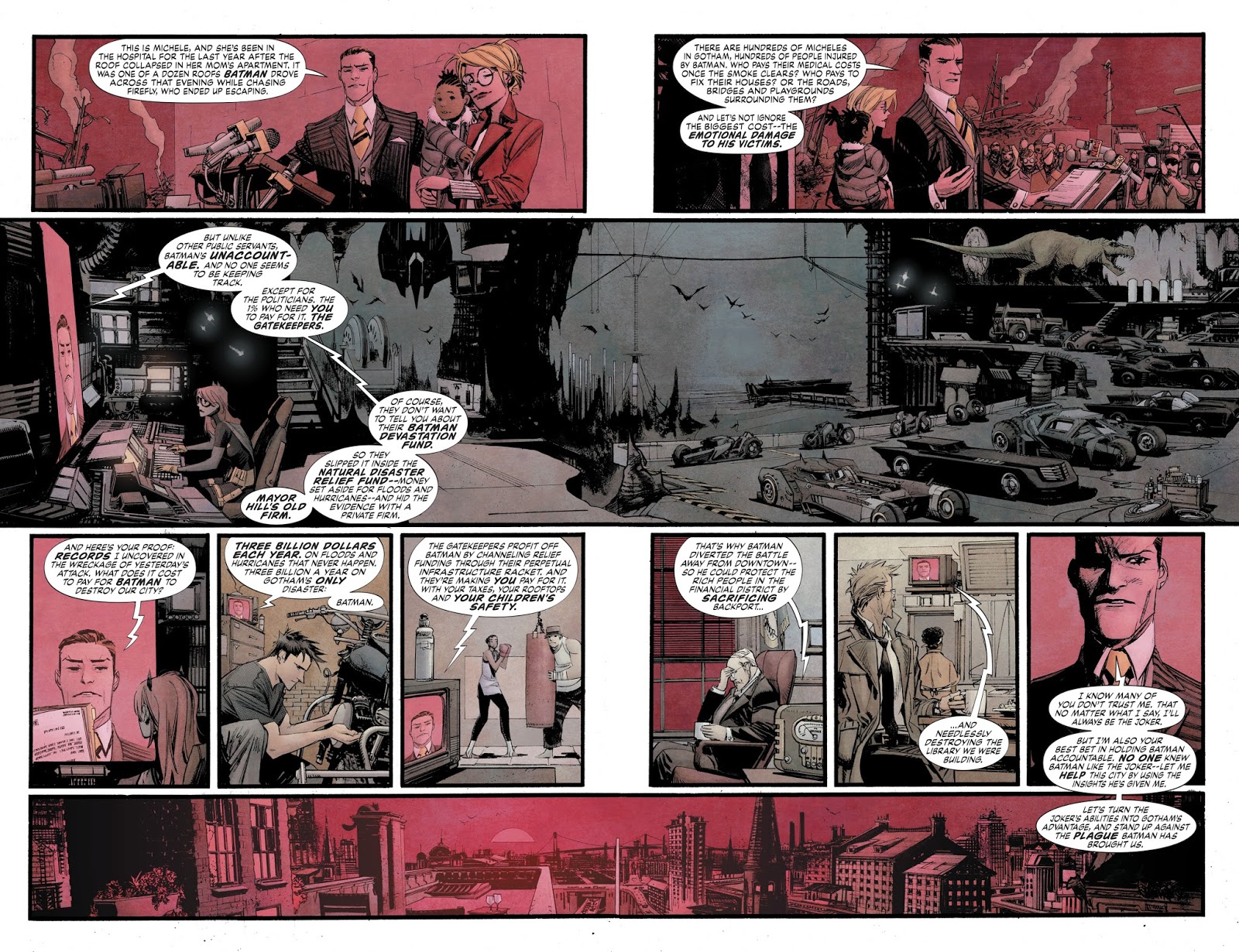
In chapter 3 of Understanding Comics, McCloud describes 6 techniques used to create transitions between comic panels. A summary of these techniques can be found on page 74 of the text. The page from Batman: White Knight above utilizes this technique in a very interesting way. Starting with the top left panel, we see Jack Napier (The Joker) making a televised speech. Napier’s speech lasts for the entirety of the 2 pages, but instead of each panel depicting him standing there and talking to us, the panels transition, using technique #3 from McCloud: Subject-to-Subject. We move from the actual site of the speech, to Batgirl in the Bat Cave, to Nightwing in his workshop, to a civilian gym in Gotham, to Alfred in the mansion, to Commissioner Gordon at a cafe, then to a close-up of the TV screen displaying Napier. This was a very compelling way to depict a somewhat lengthy speech in the comics format, and to keep the pace moving along.
The sense of in-world time was also communicated clearly within this sequence, indicated by the various speech balloons. As discussed in chapter four of McCloud (page 95), speech balloons can be used to imply time within individual panels. The reader experiences each panel for the length of time it takes them to read the dialogue in each balloon. This even emulates the experience of each character, or subject, listening to the speech on television, which added another level of immersion for me.
Additionally, I found the overall layout and design of the panels/gutters to be very creative. As McCloud mentions on page 99, “Panel shapes vary considerably though, and while differences of shape don’t affect the specific ‘meanings’ of those panels vis-a-vis time, they can affect the reading experience.” This builds from what I discussed in the paragraph above, about how the reader gets to experience what the character is experiencing because of the temporal layout of the panels and their contents. Rather than simply using generic rows of uniform panels, Sean Murphy varied the panel shapes and sizes quite interestingly. In particular, the largest panel of Barbara Gordon in the Bat Cave stands out. This panel stretches across both pages, and includes some fantastic artwork of Bruce Wayne’s subterranean compound.
Every page of Batman: White Knight features unique creative decisions which, with the help of McCloud’s scholarship, I have only grown to appreciate more.