There are two important aspects of Sacco’s approach to comics journalism present in “Chechen war, Chechen women.” The first, and most obvious, is the way Sacco makes his presence as the journalist known in various panels spread throughout the story. He draws himself into the images for the sake of not only realism but a sense of accountability. This journalism doesn’t claim to be “objective” like the work of many written news reporters, but rather it displays its subjective qualities and author partiality from the outset.
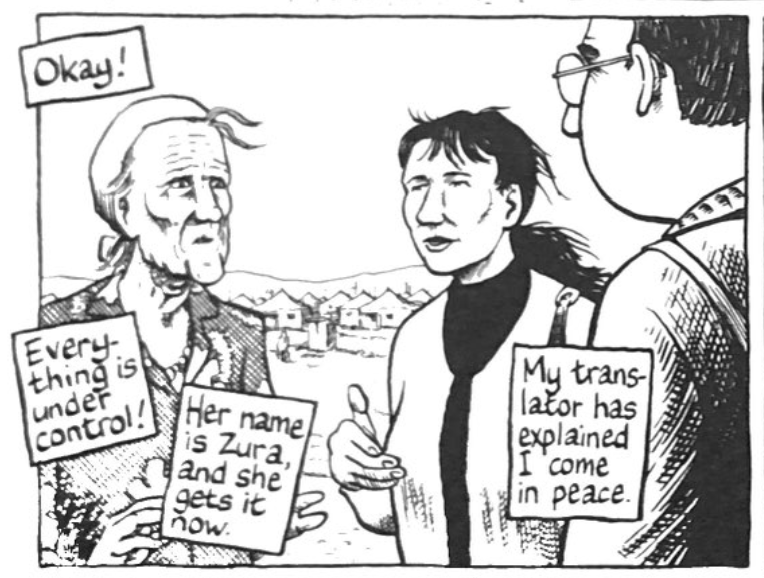
Joe Sacco is not a fly on the wall. He’s depicted as a distinct figure, albeit obscured and often huddled in the corner trying not to distract from the focus of each panel he appears in. As seen in the example above, his face is often turned away from the reader. We still see from his perspective, but he offers us consistent reminders that this is the journalist’s perspective afterall, and not some omniscient observation.
Another aspect of Sacco’s approach to comics journalism that appears in “Chechen war, Chechen women,” is the use of informed imagination. This practice builds from Sacco’s mindset of impartial realism. A few pages into the comic, Sacco breaks off into a summary of the arduous and extremely violent history between Chechnya and Russia. The panels filling these summary pages are not depicting events that Sacco himself observed, but rather using imagination to illustrate the history which Sacco thoroughly researched. Thus, the informed imagination. The information is accurate, as far as historians can tell, but the images are not necessarily real.
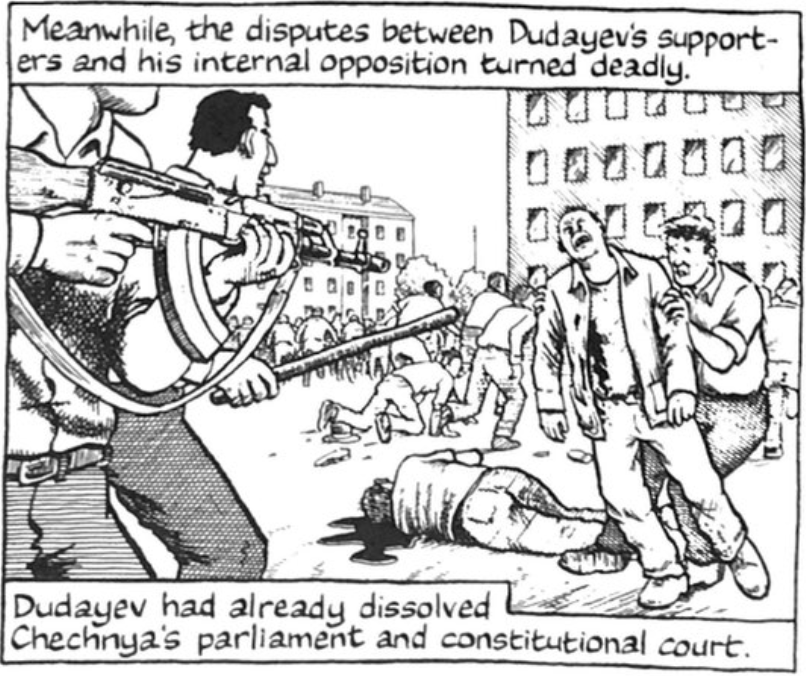
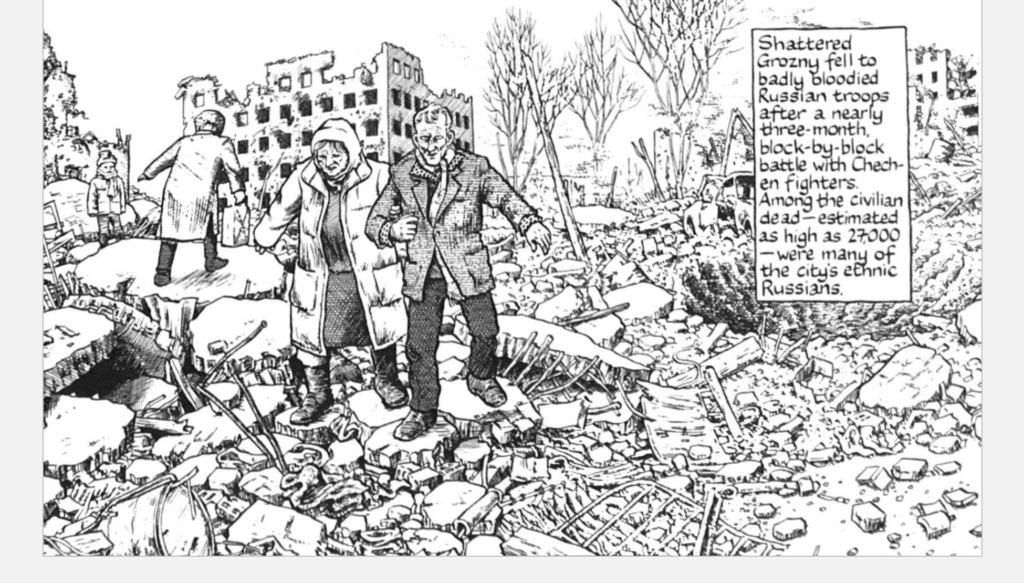
The images included above are from this historical synopsis section in the comic. While the illustrations were created based on verified information, they aren’t actually real moments in history. They are the imagined instances of reality based on historical research.
This comics journalism approach is useful for telling the story because it can truly be impossible sometimes to fully grasp the adversity and inhumane conditions that wartime refugees experience on a daily basis without the aid of certain imagery. Words can only go so far in conveying that particular reality. In the case of “Chechen war, Chechen women,” Sacco delivers the visceral nature of Chechen IDPs in a graphic format that makes it impossible not to grasp. The form of comics journalism offers accounts on world history with many more possibilities for informative storytelling than the standard practice of journalism. Comics journalism doesn’t have to rely on real photographs and footage captured of historical events, but rather written and spoken accounts inform the author/artist so that their imagination can present the rest. Sacco takes readers on a journey into the refugee camps as well as the blood-soaked history of Russia and Chechnya.